Also check out below articles
 23-02-2026
Introductory course for Google Analytics and Gemini
Google Analytics is the most commonly used statistics tool for your website28-04-2026What is the click-through rate, and how can it be improved?
There are a number of situations where click-through rate (CTR) plays a role18-05-2026Google has published a guide to optimizing for AI
You’ve surely noticed: AI (Artificial Intelligence) is changing the way we search for information online. Whether it’s Google Gemini or the new AI summaries in search results—the way content is presented is changing at a rapid pace.
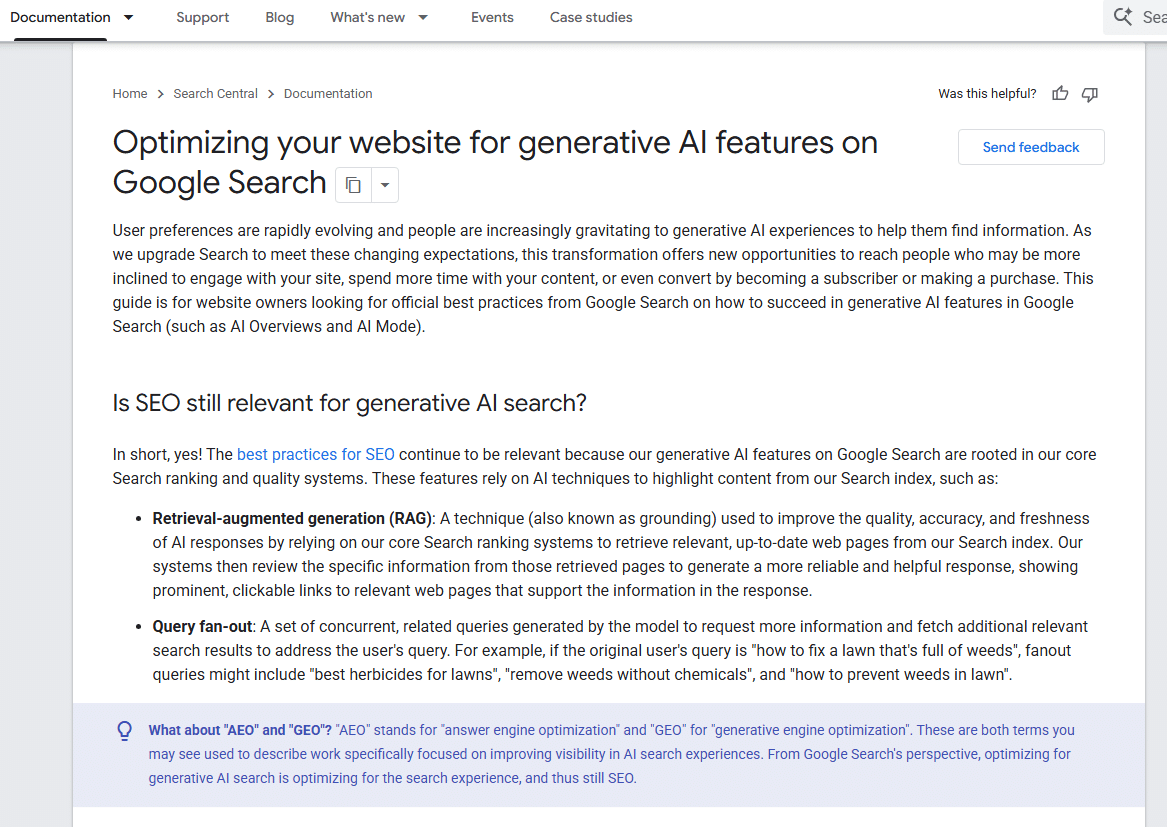
Many of these developments have already been visible in part on social media, in presentations, and through various other channels. This includes our previous blog posts. However, Google recently published an official document specifically addressing how to optimize your website for AI. In this blog post, we’ll walk you through the most important steps so you can ensure your content remains easily discoverable in this new era.
What exactly is AI optimization?
AI optimization (often referred to as GEO or Generative Engine Optimization) goes beyond traditional SEO. While SEO focuses on ranking in a list of links—how a page is structured in a search engine—AI optimization aims to make your content understandable to large language models (LLMs). The goal, of course, is for Google’s AI (and others) to use your information to formulate answers for the user—and to link back to the source for further details. This way, a visitor naturally lands on your website and, hopefully, completes a conversion there.
Key steps to make your content AI-friendly
1. Focus on “people-first” content (E-E-A-T)
Google’s AI is trained to recognize high-quality content. The core of the new guidelines remains the same: write for people, not for algorithms. The E-E-A-T principles (Experience, Expertise, Authority, and Trustworthiness) are more important than ever. AI favors sources that demonstrate genuine human experience and in-depth knowledge on a specific topic. So be sure to showcase this knowledge in your content and also outside your website.
2. Make your content accessible to Googlebot
To appear in AI-powered search results, Google must first be able to crawl and understand your website. Ensure that:
• Your robots.txt file does not block Googlebot from important parts of your website.
• You use a fast and stable hosting environment (such as at MijnHostingPartner.nl) so that Google’s crawlers can efficiently index your pages.
3. Use Structured Data (Schema Markup)
AI models love structure. By using Structured Data, you help Google immediately understand the context of your content. Whether it’s a recipe, a product review, or a “how-to” article: With the right Schema tags, you significantly increase the likelihood that your data will be used as a source in an AI response. Check your CMS (Content Management System) to see if this is already implemented, and add this additional formatting if necessary.
4. Set your own rules with the Google Extended-
A new feature in Google’s guidelines is the ability to control how your content is used to train models. Using the Google Extended User-Agent, you can specify in your robots.txt file whether Google is allowed to use your content to improve AI models such as Gemini and Vertex AI. For most websites, it is advisable to allow this if you want your content to be included in AI-driven responses.
5. Be specific and answer-oriented
AI search queries are often phrased as complete questions. Optimize your content by directly answering frequently asked questions in your niche. Use clear headings (H2, H3) and short, concise paragraphs that solve a specific problem.
Quality remains the foundation
Even as technology changes, Google’s core message remains the same: quality wins. By hosting your content on a fast server with flawless technical performance and focusing on valuable information for your visitors, you lay the perfect foundation for AI success.
Would you like to get started with a new, future-proof website? Then check out our hosting packages and ensure the speed and stability that Google’s AI crawlers expect.
Would you like to read the full document from Google itself? You can find the AI Optimization Guide here.