
 12-08-2026
What exactly are zero-click search queries?
With the emergence and now widespread use of AI in the daily lives of nearly all internet users, it makes less and less sense to create content on a website for specific questions and topics. One of the main reasons for this is the rise in zero-click search queries. Let’s take a look at exactly what this means and how you can adjust your strategy to continue creating relevant content for a website.
A zero-click search occurs when a user enters a search query into Google or an AI search engine, reads the desired answer in the results, and leaves the search engine without clicking on a website.
Think of search queries like:
“What’s the weather in Utrecht?”
“How many euros is 50 dollars?”
“When is King’s Day in 2027?”
“What kind of drill bit do I need for concrete?”
While this is ideal for users asking quick, factual questions, for websites it means that the traditional “click” leading to the actual website on the hosting server no longer occurs. This also applies to search terms that used to generate a lot of traffic in the past.
However, this often goes much further: Users can interact directly with Google’s AI (Gemini) as soon as they enter a search query—something that isn’t possible on many other platforms. Let’s take the example “What kind of drill bit do I need for concrete?”
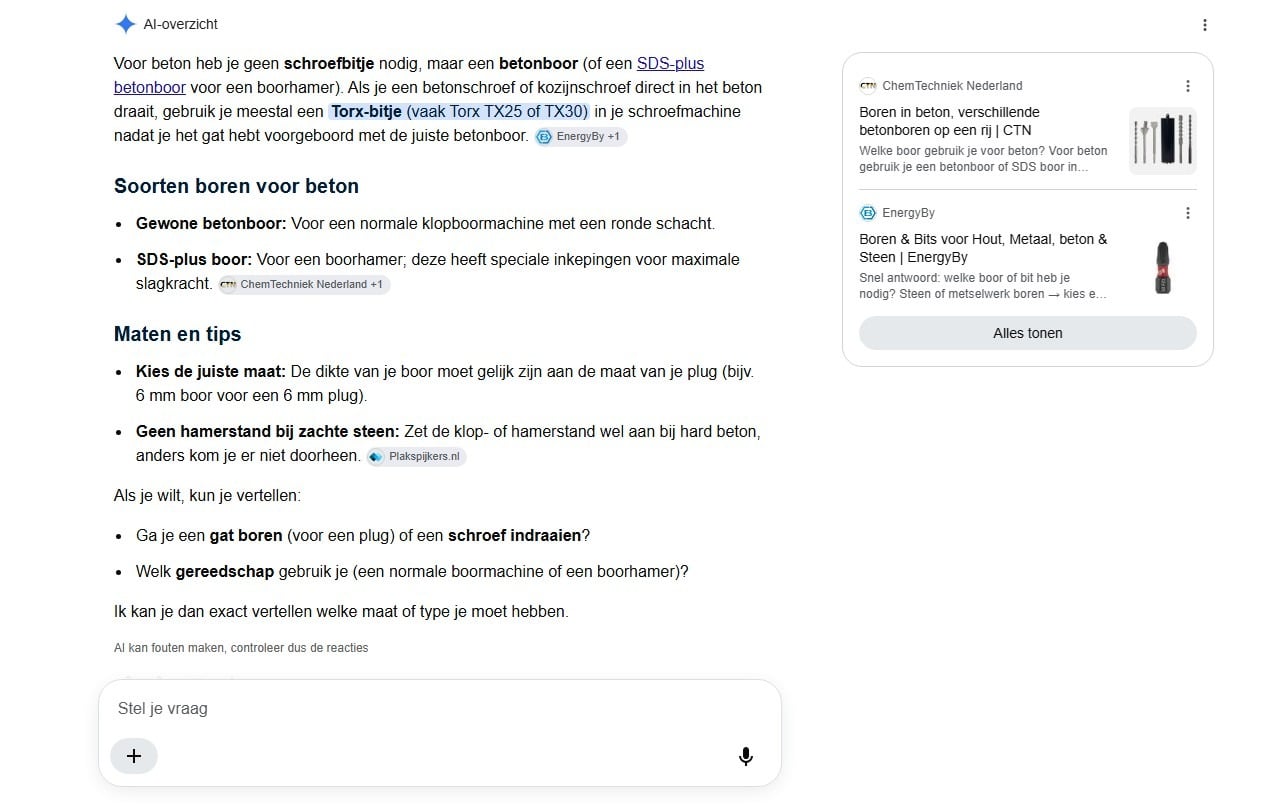
You’ll still see the websites of EnergyBy and Chemtechniek Nederland listed, which is where the information comes from. However, many users will immediately click away or continue the conversation with the AI—instead of opening the actual website the AI was trained on.
And this is where the problem for almost all website operators becomes immediately apparent: fewer or even no clicks are coming in.
Whereas previously, these search queries could still generate traffic regularly and reliably.
Why is this happening more and more often?
Search engines are evolving from a signpost (that directed users to a page) into an answer engine.
By integrating artificial intelligence (AI) and intelligent summaries, Google is trying to keep users on its own platform for as long as possible. Whereas it used to be all about simple facts, AI now directly summarizes even complex topics, step-by-step guides, and product comparisons.
How can you better prepare for this?
If searchers see the answer right away, how do you ensure that your website doesn’t become redundant? With the following 4 strategies, you can turn the zero-click trend to your advantage.
1. Focus on depth and the “next step”
Simple questions (“What is an IP address?”) quickly lead to a zero-click. Therefore, focus your content on in-depth information and follow-up questions (“How do you set up a static IP address for your own server?”).
While AI can provide a quick definition, readers will certainly click through for detailed instructions, real-world experience, or a unique case study.
2. Boost Brand Awareness
If your brand or website name is cited as a source in an AI overview or featured snippet, this may not immediately show up in your analytics statistics. But it establishes your authority.
When a searcher repeatedly sees your name as a reliable source, it builds trust. The next time that person needs a product or service you offer, they’ll search directly for your brand name.
3. Write “click triggers”
Provide a clear and direct answer in the first paragraph of your article (so Google can use it as a snippet), but immediately follow it with significant added value to encourage readers to keep reading.
Examples:
Free downloads (e.g., a guide, a checklist, or an e-book).
Interactive tools (such as an online calculator).
Exclusive images, data, or video explanations.
4. Build your own audience outside of search engines
Don’t rely 100% on organic search traffic. Make sure that visitors who do end up on your website sign up for a newsletter, follow you on social media, or subscribe to your RSS feed. This way, you’ll be less dependent on the ever-changing search engine algorithms.
The End of the Internet?
Zero-click searches don’t immediately spell the end of the internet as we know it, but they do change the rules of the game.
Instead of focusing solely on maximizing visitor numbers and cheap clicks, the emphasis is shifting toward high-quality traffic. Users who click through to your website no longer do so for a quick piece of information, but because they’re looking for your specific expertise. And those are exactly the visitors who want to become your customers!