
Also check out below articles
 02-07-2025
Google's core update has started rolling out
Google made another change to the core algorithm on June 30 as it does several28-04-2025Surfing with data protection in 2025 Brave versus Google Chrome
Protecting privacy on the internet is more important than ever. While tech17-04-2026Keyword Research: What Are Your Customers Really Searching For?
The goal of a website is, of course, to attract visitors. There are many different ways to do this, but one of the most common and important methods remains organic search results on Google and in AI-powered search engines. Let’s take a look at how you can find out what people are searching for and whether it makes sense to create content for those queries!
Conduct keyword research
Basically, it’s advisable to know which terms are used for searches in your industry or field of expertise. Let’s take an example: you’ve developed a new, high-quality stainless steel pan that was manufactured entirely according to your own specifications and expertise. Now you want to offer this pan for sale online. Your initial focus is on the Dutch market.
To create a step-by-step plan for this, it makes sense to at least activate Google Search Console for your domain name and website right now . This history is useful for building a search presence as quickly as possible.
You can then find search terms for your website in various ways; the most obvious way is, of course, Google itself. Enter terms such as: stainless steel pan, stainless steel frying pan, PFAS-free pan, and so on. In the search results, it’s advisable to pay attention to a few things.
- Which websites and what types of content are already ranking in the search results? Are these mainly online stores? Content in the form of videos? Take notes and analyze!
- Check out the section that suggests additional terms, as well as the “Other users also search for” section at the bottom of the page. Do you see relevant terms here that you can also create content for?
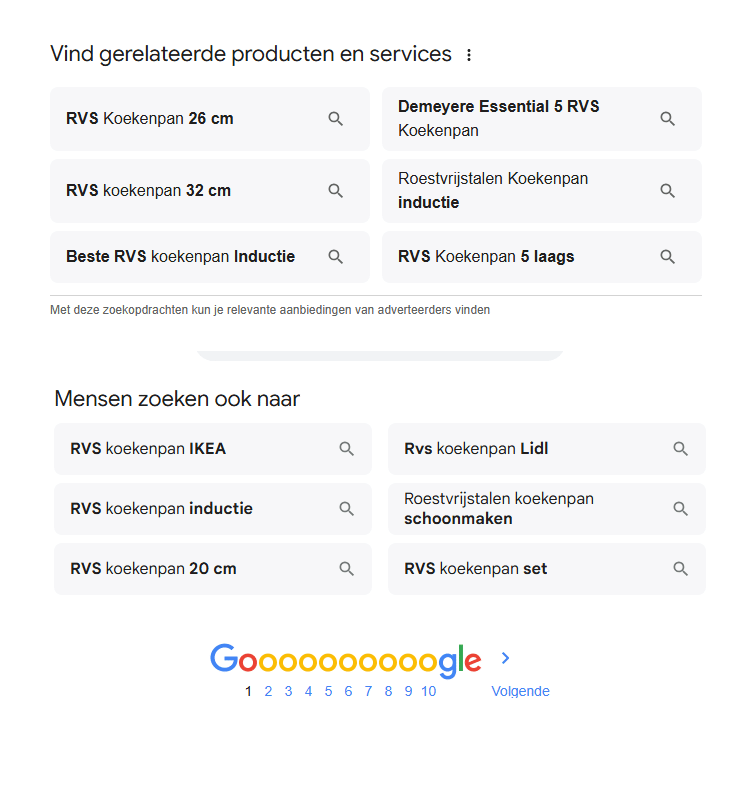
With this list of terms, you can often get off to a solid start with topics and content you can create on your website. This can take the form of blog posts, but also dedicated landing pages.
For additional terms and ideas, it’s also a good idea to consult an AI tool. Gemini or ChatGPT can often provide you with a whole list of ideas that you can further develop. Try to avoid copying and pasting AI-generated content as much as possible; even though this may yield good results in the short term, it’s questionable whether this is the right strategy in the long run.
Aligning content with a search term
To align content with a specific search term, it makes sense to think about the structure: What do you want to cover on this specific page? Jot this down briefly and draft the text’s headings right away. This will help you finish the article or page faster and stay on the main topic without digressing. Also pay close attention to the title and its formatting. Also keep in mind that longer titles are often truncated in search results.
Technical Tips
In addition to a good story, the “back end” of your page must also be right. Google and AI bots scan your website for structure and logic. Use this technical checklist:
- Use headings (H1, H2, H3) strategically:
- Use only one H1 heading per page (the title).
- Structure your text with H2 subheadings that include your most important keywords.
- Do you have subtopics? Then use H3. Never jump directly from an H1 to an H3; keep the hierarchy logical.
- Optimize your images (ALT text):
- Give your image a unique filename before uploading it (so not IMG_482.jpg, but rvs-koekenpan-pfas-vrij.jpg).
- Always fill in the ALT text. Describe what is shown in the image. This is crucial for accessibility and helps you rank better in Google Images.
- Group content into a “cluster”:
- Create a pillar page on an overarching topic (e.g., “Everything About PFAS-Free Pans”).
- Write shorter blog posts on subtopics (e.g., “How do you care for a stainless steel pan?”).
- Internal links: Link back from the short blog posts to your main page. This signals to Google that you are an authority in this field.
- URL structure:
- Keep your URL short and concise. Avoid numbers or special characters.
- Correct: your-domain.nl/stainless-steel-pan-review/
- Wrong: your-domain.nl/index.php?p=123&category=pans/
Competition for a Search Term
You’re not the only one trying to rank for a specific search term in the search results. For almost every conceivable search term, you’ll face some form of competition from others. It’s up to you to ensure that your content is better, covers more diverse perspectives, and uses original and relevant media files.
Backlinks also continue to play a major role, even in 2026. Backlinks are other websites that link to your content, but in an organic way. Buying backlinks is penalized, and acquiring backlinks through other means is also risky. As a beginner, it’s therefore advisable not to focus on this yet, but rather on the quality of your content. Internal linking within related topics, on the other hand, is highly recommended—you should start doing this from day one.
Let’s get started with your website
Keyword research isn’t a one-time task on your to-do list, but an ongoing process that recurs every day. Whether you’re selling the perfect stainless steel pan or baking the tastiest bread in town: you need to know which terms your customers use to find you.
In an online world that will be increasingly dominated by AI-driven search results by 2026, authority and relevance are paramount. By focusing on the right technology, a clear structure, and content that truly answers your visitors’ questions, you’re laying a foundation you can build on more securely in the long term.
To give you a concrete action step: Open your Google Search Console, see which terms are already generating traffic, and come up with a new topic to write a helpful article about tomorrow!